
Mairenn Attwood, Department of Zoology

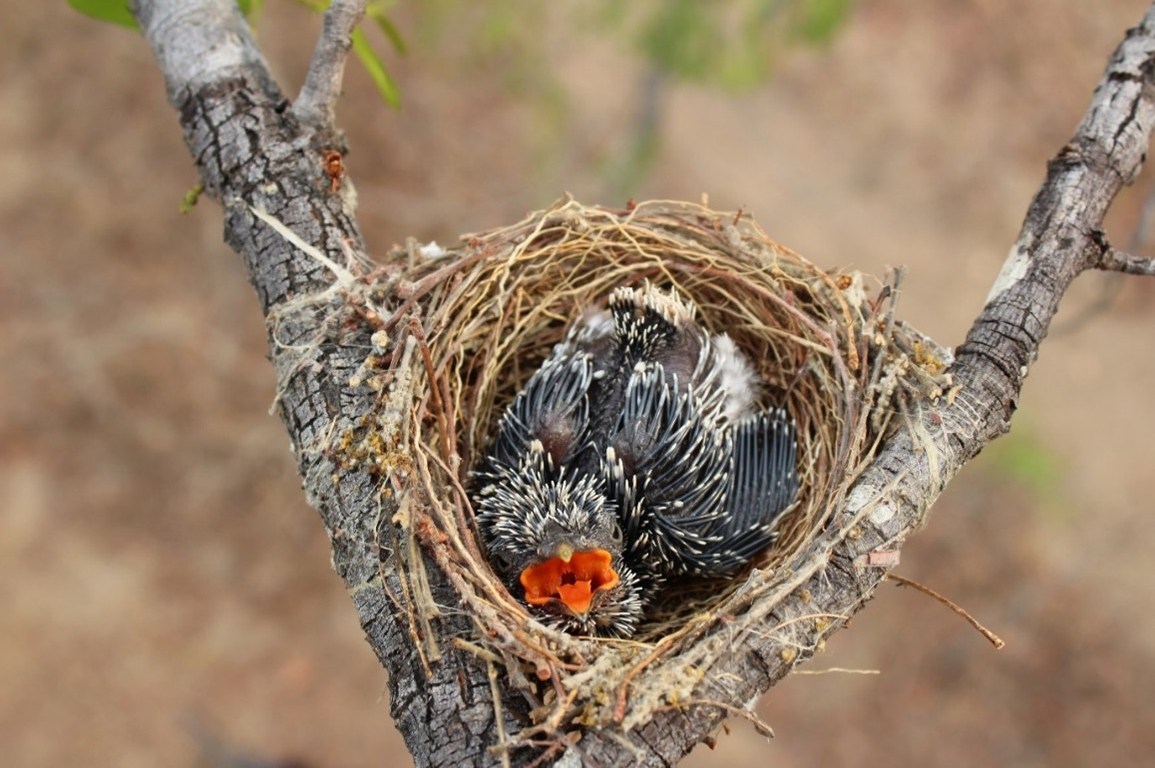
An hour after sunrise, an African cuckoo chick has just hatched. But it hasn’t hatched in an African cuckoo nest: instead of building their own nests, cuckoo parents lay their eggs in the nests of other birds. This chick has hatched in the nest of a fork-tailed drongo, and is sharing the space with a couple of fork-tailed drongo eggs.
Newly-hatched, the cuckoo chick has no feathers yet, and is still blind. That doesn’t stop its instinctive behaviour, and it sets about manoeuvring the drongo eggs in the nest – balancing one on its back, and pushing it up to the edge of the nest. With its feet braced against the twigs, it struggles to lift the weight of the egg. And then it succeeds, and the drongo egg topples over the edge, dropping four metres to the ground, and smashing.

It’s a murderous start to the day. It’s also just one act in an evolutionary battle between African cuckoos and fork-tailed drongos that has played out over thousands of years. My PhD research investigates this battle, and the adaptations both sides have evolved in defence or counter-attack.
To do this, I work with a brilliant team of field assistants to find drongo nests across a 55km2 study site in southern Zambia. Fork-tailed drongos like build their nests far out on the end of small branches, so we need to use a homemade ‘eggspoon’ – a piece of wire coiled onto a stick – to scoop eggs out of the nest one at a time and put them in a box lined with cotton wool.
Once we’ve lowered the cotton wool box, we check if there’s a cuckoo egg among them – which is a game of spot the difference. Drongo eggs have a range of different markings, from plain white, to small black speckles, to large reddish-brown blotches. If there’s one speckled egg in a nest of otherwise blotchy eggs, that’s a dead giveaway that it’s a cuckoo. But African cuckoo eggs can be extraordinary mimics of drongo eggs, and sometimes it’s difficult to tell if an ever-so-slightly different egg is a cuckoo – or just an oddly-shaped drongo. Once we’ve checked the eggs, we return them to the nest.
My research interests are in the behaviour of drongos and cuckoos. Drongos are incredible mimics of different sounds, and often mimic other birds’ calls around their nests. Sometimes they mimic the calls of hawks or African cuckoos. Part of my research is trying to work out if this mimicry works to defend drongos against cuckoos and predators. For that, I use speakers to play back drongo alarm calls and mimicry at fake nests, to see how other birds respond. I also use audiomoths (small sound recorders) to record at drongo nests continuously for days. I check these nests regularly, to see if the nest contents get eaten by predators or if a cuckoo lays an egg. This means I can work out if drongos that use mimicry have better nest survival.

I’m also investigating some of the other, more bizarre, behaviours drongos show. Drongos will happily feed a cuckoo chick in their nest – but then attack it as soon as it flies. When the cuckoo chick lands nearby, the drongos start feeding it again. I’m trying to work out why drongos show such a dramatic switch in behaviour, using 3D-printed models of cuckoo and drongo chicks, which I fly down ziplines near drongo nests.
If you’re keen to know more, have a look at our whole research group website here: https://www.africancuckoos.com/
 Museum of Zoology Blog
One thought on “How to defend your nest from predators and cuckoos: do it like a drongo”